
30 July 2026
Authors: Dr Andrew Papworth, University of York; Professor David Gadd, University of Manchester; Professor Rose Broad, University of Manchester.
We gratefully acknowledge help of the two regional police forces that shared data with us, and the work of Dr Christine Weirich in assisting with data acquisition.
- In a sample of 2,170 modern slavery crimes recorded by the police, fewer than 4% resulted in a charge.
- Female victims and sexual exploitation cases were over-represented amongst charged crimes compared with the wider dataset.
- Whilst 48% of charged crimes involved female victims, females represented 28% of victims of all crimes recorded in the data.
- Whilst 33% of charged crimes involved sexual exploitation, crimes of this type accounted for only 14% of all crimes recorded in the data.
- Almost half of the victims recorded by the police were British (49%), but 63% of charged crimes involved British victims.
Summary
We analysed 3,304 suspected modern slavery incidents reported to two police forces in northern England between 2021 and 2023, of which 2,170 were recorded as crimes.
In around two-thirds of crimes, no suspect was identified, and fewer than 4% resulted in a charge. Almost three-quarters of victims were male and almost half were under 18. This profile of victims was partly due to the predominance of criminal exploitation crimes (59% of all crimes recorded), in which over 90% of victims were male, and nearly 60% were under 18.
Crimes detected by the police were far more likely to lead to charges: although police-detected offences made up less than half of recorded modern slavery crimes, they accounted for four-fifths of crimes where people were charged.
Charging rates were higher in crimes involving female victims, and for those categorised as sexual exploitation, whilst crimes classified as cannabis cultivation and domestic servitude rarely resulted in charges.
Background
Since 2013 the British government has repeatedly promised to eradicate modern slavery. Far from diminishing as a social problem, the number of cases of modern slavery officially recorded has grown every year.
In 2025, the number of people in the UK’s National Referral Mechanism (NRM) – the official system for identifying potential victims of modern slavery and determining their eligibility for support – reached an all-time high of 23,411 people.
The annual returns from the National Referral Mechanism (NRM) consistently confirm that modern slavery most commonly involves the exploitation of British male labourers in either legitimate supply chains – notably in the construction, food preparation, and waste disposal sectors – or by criminal enterprises engaged in the cultivation and/or distribution of prohibited drugs.
This is contrary to the depiction of modern slavery and human trafficking in much news reporting and political commentary, which instead promotes the view that exploitation is a product of ‘organised immigration crime’ that preys predominantly on vulnerable women and children.
What we did
We analysed data collected by two police forces in northern England to better understand how the types of modern slavery crimes investigated by the police differ from those that result in a charge being brought.
We received an anonymised dataset of 3,304 suspected modern slavery incidents investigated by two police forces between January 2021 and December 2023, which included information about the nature of these incidents alongside basic demographic information about the linked victims and suspects. Out of the 3,304 incidents, 2,170 were investigated as modern slavery crimes.
Data wrangling and analysis were conducted within the R Studio environment. Descriptive statistics for individual variables were calculated based on all available observations, with cases included only where data were present for all variables required for a specific summary or comparison.
Key findings
A suspect could not be identified in two-thirds of the 2,170 incidents classified by the police as crimes. Less than 4% of recorded crimes resulted in a suspect being charged.
Almost three-quarters of victims were male and almost half were under 18. This was partly because criminal exploitation – which often involves predominantly male perpetrators coercing younger men into committing crimes – comprised 59% of the crimes where the exploitation type was known.
Breakdown of crimes by different exploitation types
- Criminal exploitation constituted 59% of the modern slavery crimes in the dataset. Of these, 67% of the victims were British, 90% were male. Only 3% of these crimes resulted in a charge.
- Cannabis cultivation constituted 10% of the modern slavery crimes in the dataset. Of these, less than 3% of the victims were British (67% Albanian), 95% were male. Only one crime of this type resulted in a charge.
- Domestic servitude constituted 4% of the modern slavery crimes in the dataset. Of these, less than 2% of the victims were British (53% were Pakistani), 9% were male. None of these crimes resulted in a suspect being charged.
- Forced labour constituted 11% of the modern slavery crimes in the dataset. Of these, 5% of the victims were British (36% were Albanian), 92% were male. Only 4% of these crimes resulted in a charge.
- Sexual exploitation constituted 14% of modern slavery crimes in the dataset. Of these, 58% of the victims were British, around 9% were male. Only 8% of these crimes resulted in a charge.
Police-detected cases were far more likely to lead to charges than those reported by other statutory service providers, local authorities and the public. Four-fifths of those crimes that ultimately led to charges being brought had initially been detected by the police, even though police-detected offences accounted for less than half of the modern slavery crimes in our dataset where this information was known.
Female victims were overrepresented in charged crimes. While females made up 28% of victims overall, they were involved in 48% of charged crimes. None of the crimes labelled as being related to domestic servitude – in which 91% of the victims were female and 9% male – resulted in a suspect being charged. In contrast, sexual exploitation cases were more likely to result in a charge. Although sexual exploitation accounted for 14% of crimes in the overall dataset, they accounted for 33% of crimes that resulted in a charge. Victims in these cases were predominantly female (91%). As shown in Table 1, crimes involving the sexual exploitation of a female victim had the highest charging rate in our dataset (although this was still less than 10% of all the investigated crimes with these characteristics).
Table 1: Charged status by exploitation type, and the age and gender of the victims*
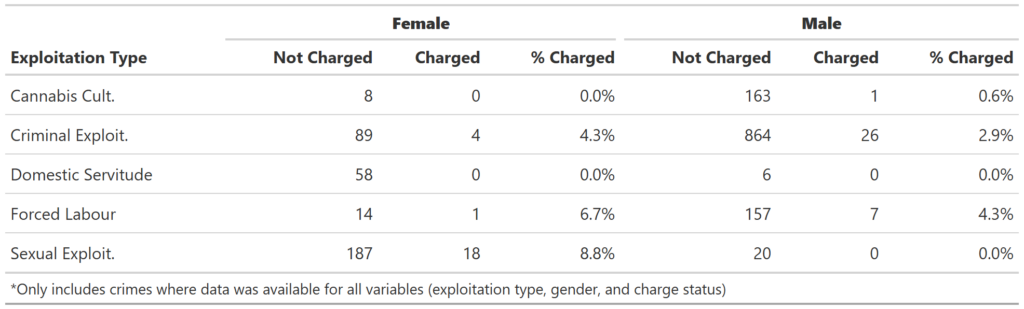
As a result, crimes involving females being sexually exploited featured more prominently amongst the crimes that were charged than might be expected from the wider dataset of recorded crimes. Figure 1 (below) shows that amongst the 546 crimes involving men who were under 18 and criminally exploited, 11 resulted in a charge; and amongst the 126 crimes involving women who were under 18 and sexually exploited, there were also 11 crimes that resulted in a charge.
Figure 1: Charged status for criminal and sexual exploitation by victim demographics

This has implications for the types of modern slavery cases presented in court and, in turn, those most often reported in the media and discussed in public debate. Although they represent a smaller share of recorded modern slavery offences, cases involving foreign national organised crime groups engaged in sexual exploitation often attract greater media attention once charges are brought than more common forms of modern slavery that less frequently result in prosecutions.
Next steps
The project team has secured access to police investigation and probation records relating to modern slavery cases and has used these to develop focus group schedules covering criminal exploitation, cannabis cultivation, home takeovers, labour exploitation, adult sexual exploitation, and domestic servitude. The focus groups will be conducted with survivors of exploitation and professionals involved in tackling modern slavery. Comparing the perspectives of these groups will inform recommendations to improve police and policy responses to modern slavery.
Contacts
- Professor David Gadd: [email protected]
- Professor Rose Broad: [email protected]
The support of the Economic and Social Research Council (ESRC) is gratefully acknowledged. Grant reference number: ES/W002248/1.