

3 September 2025
Research team: Lewis Shaw, University of Leeds; Matthew Warburton, University of Leeds; Sam Denny, University of Leeds; and Professor Dan Birks, University of Leeds.
- The team explored relationships between school absence, academic attainment and later NEET status in over 15,000 Bradford-based children that attended school between 2005 and 2018.
- Higher levels of absence and lower levels of attainment are related to increased NEET risk while accounting for pupil demographics.
- Our findings suggest that academic attainment plays an important role in the relationship between absence and NEET risk. However, that role is much greater where absences are authorised compared to unauthorised.
- This indicates that for pupils with high levels of authorised absence targeted academic support could help mitigate NEET risk. Conversely, high levels of unauthorised absence may require consideration of wider disengagement, behavioural issues, or social circumstances.
Summary
Using Department for Education (DfE) data describing the educational trajectories of over 15,000 Bradford-based children, this project explored how school absences and academic attainment (number of GCSE passes A*-C / 9-4) are related to the risk of becoming NEET (Not in Employment, Education or Training).
Using structural equation modelling, we found that both absences and attainment have a strong relationship with NEET risk, and that GCSEs have a substantial mediating effect on the relationship between absence and NEET outcomes.
The relationships between absence, attainment and later NEET status varies depending on whether absences are authorised or unauthorised. Findings suggest the negative impact of authorised absences could be mitigated by targeted academic support but that the impact of unauthorised absences may require more holistic interventions.
Background
The transition from education into employment is a crucial time in which young adults develop financial independence, the ability to make independent life decisions, and take on responsibilities.
NEET status is used to monitor post-secondary school destinations and in recent years, has been used as a marker for youth disengagement from society. Studies have found that NEET individuals are more likely to experience a variety of long-term effects including mental health problems, economic disadvantage and social exclusion. NEET status has also been associated with higher rates of suicide, substance abuse and criminal involvement.
The Office for National Statistics (ONS) estimated that 946,000 young people aged 16-24 in the UK were classified as NEET from July 2024 – September 2024. This accounts for 13.2% of people within the age group. Consequently, the number of NEET individuals is an ongoing concern in the UK – with recent high levels of youth unemployment leading to an increased interest in social policy regarding transitions from education into employment.
Previous research has established strong correlations between school absences, academic attainment, and future NEET status. This project sought to advance understanding of the relationship structures between absence, attainment and subsequent NEET risk using routinely collected population-level data.
What we did
Using the Connected Bradford Research Database to access various DfE administrative datasets, a custom pupil-level dataset was created which combined absence records, GCSE results, and pupil demographics, with a measure of NEET status after secondary school.
This dataset described 15,267 Bradford-based pupils who attended primary and secondary school between 2005 and 2018.
Absence was measured through 11 years of authorised and unauthorised absence records (academic Years 1 – 11), academic attainment by the total number of GCSEs achieved from A*-C, and NEET status by whether an individual had been recorded as NEET at any point after secondary school between the ages of 16 and 18.
Using the data, this project sought to:
- Evaluate the relationship between school absences and the subsequent risk of individuals becoming NEET.
- Evaluate the relationship between academic attainment and NEET risk.
- Explore academic attainment as a mediating factor between school absence and NEET outcomes, where absence relates to attainment which in turn relates to NEET risk.
To answer these questions, we employed structural equation models, due to their capability to assess complex relationships between multiple variables simultaneously.
Key findings
Consistent with previous studies, preliminary analyses established strong relationships between school absences (across the whole school period), academic attainment (number of GCSE passes A*-C / 9-4), and NEET status following secondary education.
Specifically, those who had greater absence rates were more likely to perform worse on GCSE assessments and to become NEET, and those who performed worse at GCSEs, regardless of absence rate, were also more likely to become NEET. These relationships held when accounting for gender, ethnicity, Special Educational Needs (SEN) and free school meals eligibility.
Using structural equation models, we were then able to explore how the relationship between school absence and NEET status is mediated by GCSE performance. This means that as well as assessing the direct relationship between the two, we are also able to explore how school absence relates to GCSEs which in turn relates to NEET risk. Our model estimates that 55% of the association between school absence and NEET operates through attainment, suggesting that academic performance may play a key role in how absence relates to future NEET status.
Absences were then separated into authorised (e.g. illness, holiday) and unauthorised (e.g., lateness, truancy). Almost all the relationship (98.3%) between authorised absences and NEET status is related to GCSE performance. This finding suggests that pupils with high authorised absence rates may fall behind due to missed learning opportunities, which impacts academic performance, increasing NEET risk. One possible implication is that providing academic catch-up support such as tutoring or flexible study options could help reduce their NEET risk.
Differentially, for unauthorised absences, GCSE performance accounts for much less (42.8%) of the relationship with NEET status. This finding suggests that unauthorised absences largely relate to NEET outcomes independent of their shared relationships with academic performance, and that other factors—such as disengagement from education, behavioural issues, or wider social circumstances—may also play a key role.
The following heatmap shows a grid of estimated probabilities that pupils would become NEET based on school absences (x-axis) and total GCSEs passed (y-axis) using our statistical model.
Within the cohort, we observed that 52% of pupils with low absence rates (≤5%) managed to achieve 8 or more GCSEs at a pass level. Comparatively, for pupils with higher absence rates (≥10%), 41% achieved 0 GCSEs at a pass level.
Based on these patterns, our model estimates that pupils with low absence (≤5%) and high GCSEs (≥8) have a maximum NEET risk of 2%, while pupils with high absence (≥10%) and no GCSEs have a minimum NEET risk of 18%. We therefore estimate that pupils with higher absence and low attainment face at least nine times the risk of becoming NEET after secondary education.
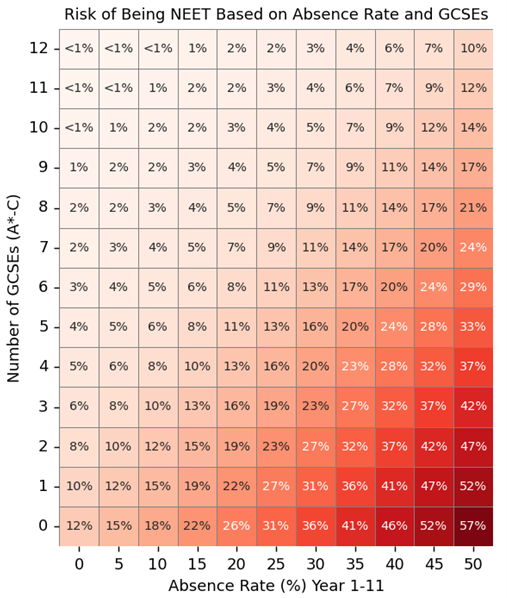
Figure 1. Risk of being NEET based on absence rate and GCSE attainment
Next steps

The analyses presented in this report indicate that authorised and unauthorised absences are associated with different patterns of academic attainment and future NEET status.
While this study employs a more sophisticated analytical approach than most prior research, our use of administrative data means we cannot make definitive causal conclusions. Future research could explore whether support strategies tailored to different types of absence produce measurable improvements in educational outcomes and postschool trajectories.
Our current NEET measure is based on whether an individual became NEET at any point in time, which may include very short periods of NEET status. Future work could establish various persistent NEET measures such as consecutive NEET periods of 3-6 months or 6-12 months to explore how various schooling factors relate to long-term NEET risk.
Contact
- Centre Deputy Director: Professor Dan Birks, [email protected]
Acknowledgements

This study is based in part on data from Connected Bradford (REC 18/ YH/0200 & 22/EM/0127). The data is provided by the citizens of Bradford and district, and collected by the NHS, DfE and other organisations as part of their care and support. The interpretation and conclusions contained in this study are those of the authors alone. The NHS, DfE and other organisations do not accept responsibility for inferences and conclusions derived from their data by third parties.

This project was conducted in collaboration with the Leeds Institute for Data Analytics and its Data Scientist Development Programme, which trains early-career data scientists to deliver real-world, data-driven impact.
The support of the Economic and Social Research Council (ESRC) is gratefully acknowledged. Grant reference number: ES/W002248/1.