
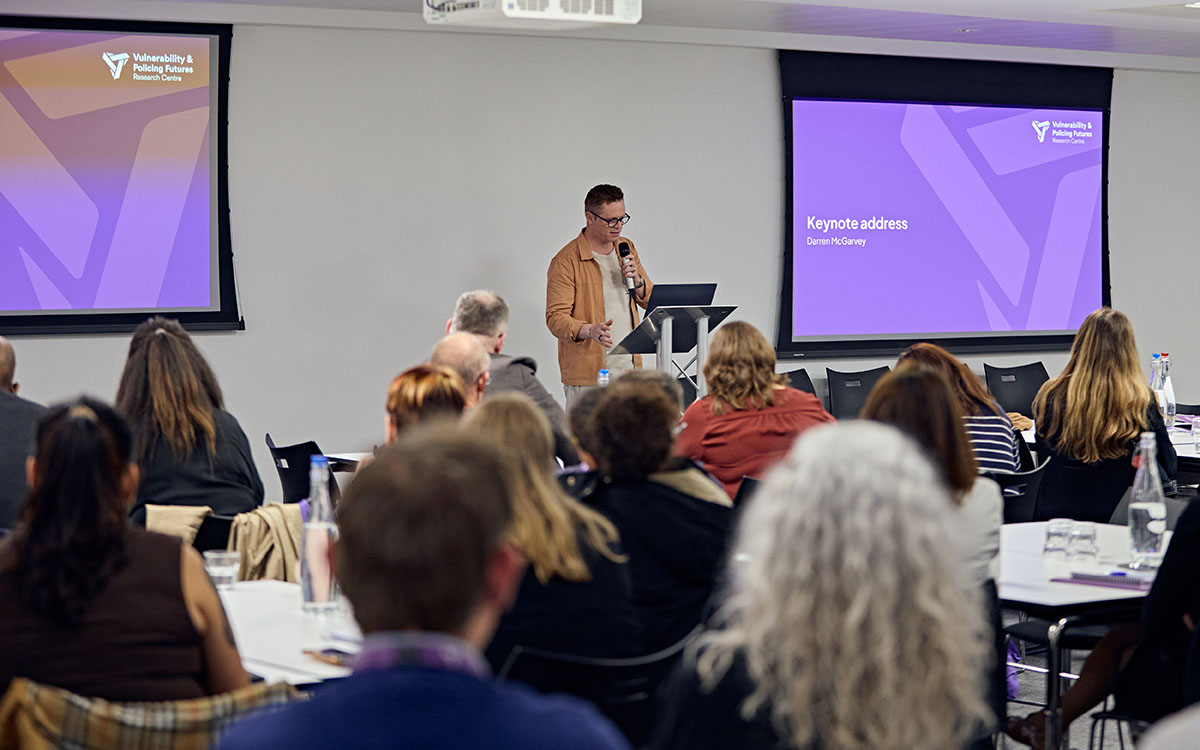
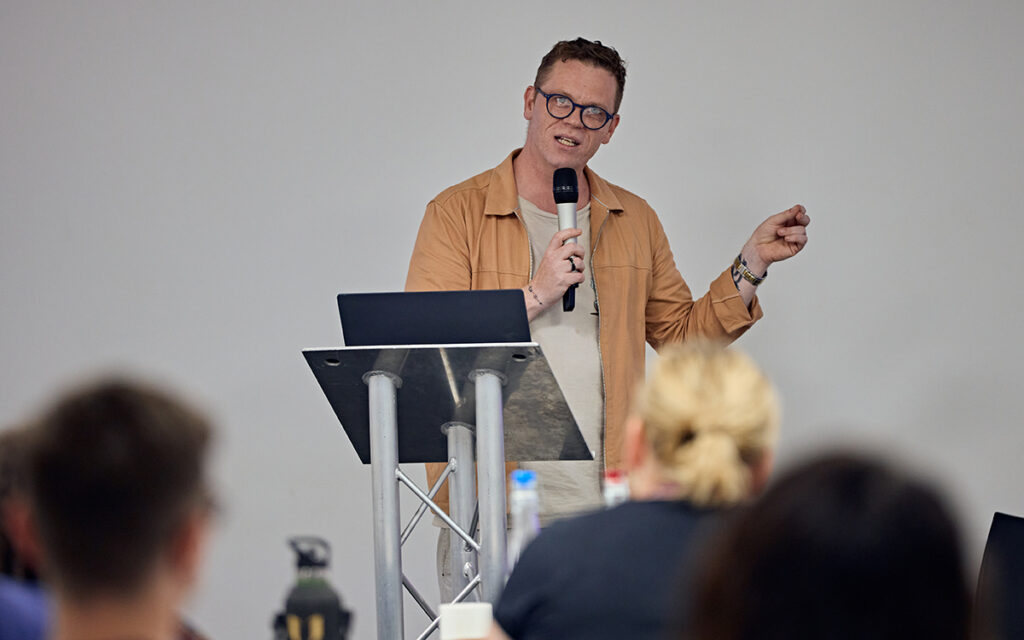
As part of our annual conference ‘Vulnerability and Policing: Reducing Harm, Strengthening Justice’, we were delighted to welcome Darren McGarvey as a keynote speaker. Read his keynote address below.
Published 18 December 2025.
I should say at the start, I’m not here as a policymaker, or a criminologist, or a think-tank person who speaks entirely in bullet points. I’m what’s known as a professional pain in the arse. Which is to say: someone who pays close attention to social systems. Who notices the gaps between what they say they’re or think they’re doing and what they’re really doing.
Today, we’re talking vulnerability. Of course, one’s own sense of vulnerability is just one facet of vulnerability as a whole. Today, we hear the term ‘vulnerable’ all the time. Vulnerable families. Vulnerable women. Vulnerable children. You almost never hear about vulnerable banks, vulnerable landlords, vulnerable corporations—despite their surprisingly delicate constitutions whenever accountability is mentioned.
We use “vulnerable” as if it’s an essence buried inside specific people—fragile, deficient, broken. But look around. What if vulnerability isn’t inside people at all? What if it’s in the lift that never works; the mould on the walls; the zero-hours contract; the classroom with thirty-two kids and one exhausted teacher; the bus that never arrives?
That’s today’s argument: vulnerability is a relationship, a co-production—between people, institutions, and power. When we follow that thread through welfare, crime, policing, trust, and the means by which we “know” what we know, we see something uncomfortable: the systems built to manage vulnerability often manufacture it.
How many of you have ever watched a decision be made that you knew would make things worse, but the spreadsheet said it was fine?”
“Vulnerable” sounds compassionate. It rarely functions that way.
Label someone “vulnerable” and the label sticks. It turns into an identity: to be managed, supervised, risk-assessed, spoken for. And once we individualise it, we stop asking structural questions. Instead of: What in the environment is making life precarious?—we ask: What’s wrong with them? Worse still, once the label has been applied by officialdom, people often buy into it themselves. That wouldn’t be a problem if the framing were accurate. But too often, vulnerability is ascribed to individuals or communities without proper regard for the systems dominating their lives.
Picture this: a flat where wallpaper bubbles and paint peels, a sweet, fungal smell thick in the air. In the middle of a barely furnished room, an eighteen-month-old child watches the television, his breath visible in the cold. His single mother, recently escaped from an abusive partner, is on the phone to the local authority. She insists the damp and freezing temperatures are worsening her son’s respiratory problems; she even has a GP’s letter to prove it. But there’s no move on offer: social housing is scarce, and every unit that becomes available triggers a fierce competition, with endless assessments and reassessments for eligibility.
So the family stays put. The condensation spreads, mould creeps up the walls, the flat stays cold. And every month, despite the unliveable conditions, the landlord collects £900 in rent, paid directly by a government agency. Only years prior, this very flat was part of social housing stock and available for a third of the price, fully furnished. Today, it’s a death trap creating a passive income for an absentee property owner.
On the official file, the mother and child are recorded as a “vulnerable household with complex needs.”
That phrase sounds scientific. It also functions like a magic trick.
“Vulnerability”, as so often deployed in the UK, moves our gaze away from systems and onto the people living under them. We stop talking about poverty rooted atrocious industrial strategy and talk about “vulnerable families.” We stop talking about austerity rooted in the greed of bankers and talk about “vulnerable communities.” It’s linguistic insurance, and the cost is borne always by the people who can least afford it.
And who gets called vulnerable is often political. The woman facing domestic abuse is “vulnerable.” The same woman organising a campaign becomes “aggressive.” The child is “vulnerable” in a children’s panel review, but “disruptive” in worthy of exclusion in a classroom. The labels swivel to suit the institution, framework or policy.
Vulnerability is not an essence; it’s an exposure. Change the environment—income, housing, education, safety—and you change the vulnerability. Which makes vulnerability political, situational, and in so many cases, solvable.
Crime, Welfare, and the Suspicion Machine
We are often told we can police our way out of violence, punish our way out of addiction, criminalise our way out of exploitation. Yet as many of you know, there is a vast gulf between the headline-grabbing rhetoric of senior politicians and the reality faced on the frontline. You cannot police, punish, or criminalise your way out of poverty. All you can do is refine the methods of punishing people for being poor—and gaslight yourself into believing it’s innovative.
Which brings us to the welfare state, and the quieter but no less powerful role it plays in reinforcing outdated attitudes about crime, punishment, and the division between the “deserving” and “undeserving” poor. In this way, “vulnerability” becomes the language that dresses up suspicion and punishment as care—turning a structural problem into an individual condition.
Imagine walking into a welfare office. The poster says: “We’re here to help.” The conversation says: “Prove it.” There are hoops: job search logs, mandatory courses, appointments you must not miss, apps you must check, forms you must not mis-tick. Miss one hoop and the floor opens—sanction. Bereavement is suddenly cause for a compliance meeting. Disability is suddenly cause for investigation. A fresh coffee, or a takeaway is suddenly a luxury item.
This isn’t a safety net; it’s a low-rent FBI. A clumsy, punitive compliance regime, designed not to support people back to work but to create aesthetics which deter people from asking for help. The post-war welfare state promised solidarity: we all put in, we all get out. The contemporary version behaves less like a friend we turn to in hard times, and more like a controlling partner:
- Where were you yesterday?
- Why didn’t you answer the phone?
- Do you have proof that’s what you were doing?
- If you don’t comply, there will be consequences – I’ll cut off your money, I’ll isolate and shame you.
It mirrors coercive control: surveillance masquerading as care, punishment disguised as help, isolation enforced by conditionality. And like the abuser, the system says it’s “for your own good.”
Conditionality doesn’t build motivation; it builds anxiety. It’s stop-and-search with paperwork.
And here’s the irony: desperation is criminogenic. Push people to the edge and some will step into survival economies. Treat people as suspects long enough and some will live up to the suspicion. For many, the criminality born of poverty, low opportunity, and institutional suspicion generates a further wave of harm: gang violence, knife and gun crime, drug dependency, and death. The welfare system punishes you for being poor; the criminal justice system punishes the ways you cope with poverty. Together, they are two halves of the same problem—each manufacturing vulnerability while claiming to manage it.
Where do the police fit? Increasingly asked to be social workers, mental-health responders, housing triage, youth workers—while welfare officers act like police. Everyone is doing everyone else’s job, except the one job nobody is resourced to do: alleviate harm.
My proposition on policing is narrow: provide immediate safety—protect people in the moment. But do not pretend policing can fix poverty, trauma, addiction. Prevention lies in adequate housing, employment and education, stable income, health and security. Starve those and you force the police to stand where the state has been hollowed out, then ask naively why trust is gone.
Distrust is not a Pathology
We hear about “pathological distrust” in certain communities. As if distrust were a virus. Hard-to-reach populations who refuse to engage. But if every institutional door you’ve knocked has opened onto punishment, delay, or disdain, distrust is not pathology; it’s pattern recognition.
Consider the first time someone reports violence. The response is procedural, minimal, or blaming. Consider the first benefits claim—the sanction arrives before the support. Consider the first school meeting—the label lands before the help. After two or three rounds, you stop approaching doors that open onto harm. That isn’t irrational, it’s learning.
Distrust spreads across the state like damp across a wall: police to social work to education to health. Not because people are allergic to institutions, but because institutions have taught them what to expect.
“Kinder first responses” isn’t a soft add-on. It’s the hinge. If the first knock on your door is suspicion, you close the door. If the first question is “Are you okay?” you might let someone in.
But kindness costs time, attention, staff—resources. We’ve stripped those. So even the kindest worker is forced into risk management: throughput over trust, metrics over listening. The system is unkind by design, and good people are conscripted into reproducing it.
Result: People don’t trust institutions. They survive them. And people who idealistically hope to change those very systems by working within them, are slowly battered into submission.

Victims, Offenders, and the Human Mess
Our systems love a clean binary: victim here, offender there. On paper, it organises services. In real life, it collapses.
Take a teenager caught up in a county-lines network: groomed, threatened, exploited. Victim. The next minute: arrested with drugs or a knife. Offender. Which is he? The system forces a choice. Real life is more complex.
Women in prison: overwhelmingly survivors of abuse, poverty, and instability. Victims and criminalised offenders at the same time.
And look at young offenders more broadly. A high proportion are care-experienced, shaped by years of instability, loss, and fractured attachments. Many carry the scars of abuse and neglect. Others show behavioural patterns rooted in developmental problems from their earliest years. Some have brain injuries never diagnosed. Others were exposed to Class A drugs or alcohol in the womb, with lifelong consequences for impulse control, learning, and judgement.
So where do they fall on the binary? Victim, or offender? Survivors of harm, or producers of it? The answer is usually: both.
The human mess resists neat categories. Yet our services are built like flat-pack furniture—everything must fit the slots.
The binary hides the cycles of harm: how victimisation and offending braid together; how survival strategies look like “risk”; how yesterday’s injury becomes tomorrow’s incident.
The question is simple: do we want a system that manages labels, or one that reduces harm?
Ways of Knowing: When the Spreadsheet Wins
Categories are powered by knowledge systems—data dashboards, risk matrices, academic frameworks, performance targets. Governments love counting “at risk” groups. But when the spreadsheet says one thing and the neighbourhood says another, the spreadsheet usually wins.
Imagine a young man who is nowhere on the lists: no exclusion, no record, no flag. On paper: fine. In reality: sofa-surfing, carrying a knife to feel safe, sleeping in ten-minute bursts, no future horizon. He doesn’t exist until something happens. Then he exists as an incident.
When official knowledge repeatedly contradicts lived reality, distrust deepens. People see their lives reduced to proxies, their needs translated into compliance tasks.
So, whose knowledge counts? Statistics, professional expertise, lived experience.
Each has a blind spot. Statistics without humanity becomes abstraction. Professional expertise alone gravitates toward institutional convenience. And lived experience—well, that’s more complicated.
Because in recent years, lived experience has become its own kind of currency. Policy forums, academic panels, third-sector conferences all like to showcase “real voices.” A personal testimony is wheeled out. A traumatic story is told. Everyone nods gravely. It feels authentic, emotional, true.
But here’s the problem: performative lived experience storytelling can create the impression that new knowledge is being generated, when in fact what’s happening is performance. The story becomes a product—polished, repeated, consumable. And once it is consumed, the audience feels they have “heard from the vulnerable” and therefore know something they didn’t before.
Except often, they don’t. They know a performance, not a reality. The narrative has been selected, shaped, sometimes even scripted to align with organisational priorities.
It’s not that the storyteller is dishonest—it’s that the system demands a particular kind of honesty. One that is neat, packaged, palatable. One that confirms the categories that already exist.
And so “lived experience” ends up reinforcing the very binaries and assumptions it was supposed to disrupt. The powerful leave the room moved but unchallenged, affirmed in their sense that they are now “listening to voices.” Meanwhile, the structural causes of harm remain untouched.
That doesn’t mean lived experience has no value. Quite the opposite. It is indispensable. But when it is used as spectacle, or as data substitute, it risks becoming just another performance metric.
The real value of lived experience is not in producing catharsis for professionals—it’s in exposing the mismatch between official categories and lived realities. That requires dialogue, dissent, contradiction, not just performance.
So what we need is a parliament of knowledges—numbers, practice, and lived reality in conversation, with none allowed to dominate. Not sentimentalising experience, not fetishising data, not deferring blindly to professionals. But insisting that each corrects the blind spots of the others.
Because if we don’t, we keep building policy on category mistakes—trusting the spreadsheet over the street, the performance over the pattern, the anecdote over the analysis. And those mistakes don’t stay abstract. They show up in people’s lives, in the gaps, in the harms, in the distrust.
Beyond Class Alone: Widening the Lens
A lot of my critique bites hardest around class and poverty. But vulnerability is never just about class. It is also shaped by gendered violence, racism, ableism, immigration status, sexuality, language, and law.
The “vulnerability industry” often treats these as tick-boxes: a diversity matrix, an intersectional pie chart, a bullet-pointed list of disadvantages. But people don’t live them separately—they live them as interlocking pressures.
If your immigration status is insecure, every door you knock is a risk. If you’re a Black boy in a city where stop-and-search is routine, safety is something you must manufacture around surveillance. If you’re disabled in a system that treats assistance as suspicion, every request for access is an audit. If you’re a woman reporting abuse, the stereotype of hysteria or exaggeration follows you into the room before you’ve even spoken.
Stigma and stereotype aggravate the harm. They make services less trustworthy, encounters more hostile, and outcomes worse. Vulnerability isn’t just exposure to harm—it’s also exposure to misrecognition: being seen through a lens of deficit, pathology, or stereotype.
And here’s the trap: once groups are stigmatised and stereotyped, they are pitched into competition with each other for scarce resources and recognition. The “deserving” poor against the “undeserving.” Migrants versus citizens. Survivors of one form of abuse measured against survivors of another. Communities end up fighting for the spotlight, competing for fairness, demanding acknowledgement.
It becomes a sideshow: vulnerable groups turned into contestants, while the real problem—the system that underfunds, divides, and mislabels them—sits in the audience, unchallenged, applauding itself for running the show.
We cannot build safety on a single axis, and we cannot build fairness by pitting one vulnerable group against another. If the front door reads Welcome but the side door reads Hostile Environment, people get the message. And the message is this: the system decides who counts, who matters, and who gets left outside.
The Welfare–Policing Feedback Loop (Spelling it Out)
Let’s trace the cycle of vulnerability:
- Material precarity (housing, income, health, schooling) creates exposure to harm.
- Systems respond with conditionality and surveillance—administered suspicion as policy.
- People adapt with survival strategies—some licit, some illicit.
- Policing enter clumsily to manage visible symptoms.
- Trust erodes, making help-seeking less likely, making enforcement more likely.
- The loop closes with data that justifies more suspicion, because the only things measured are the things visible to enforcement.
We call this “managing vulnerability.” It’s re-producing it.
So—where does this leave us?
We’ve seen how vulnerability functions as a label that sticks to people and slides off systems. How the welfare state has been refitted into a suspicion machine. How policing is asked to stand where welfare has been hollowed out. How distrust is not a disease but evidence. How the victim/offender binary collapses in real life. How the ways we “know”—our spreadsheets, our proxies, our performances—can betray the very people they claim to describe.
Thread it all together and it says this: we are manufacturing the very vulnerability we claim to manage.
So what’s the alternative?
- Stop pathologising people; start interrogating systems. Treat vulnerability as exposure created by policy and environment, not an essence in a person.
- Invest in the boring miracles—income, housing, education, health—because that is where safety is quietly made.
- Design for complexity. Refuse the tidy cruelty of either/or categories.
- Make “kinder first responses” the rule. Stabilise first, verify later.
- Take distrust seriously. Not as a flaw in people to be corrected, but as a verdict on institutions to be transformed.
- Let a parliament of knowledges lead. Numbers, practice, lived reality—in dialogue, with dissent welcomed, hype filtered out.
- Communicate across government under an overarching vision. Vulnerability crosses silos; so must the solutions. Campaigns like the Health Foundation’s Health Equals show how a unifying frame can help align sectors that usually speak past one another.
Because without that vision, institutions retreat into silos and people get lost in the gaps. With it, we can start to see vulnerability for what it really is: not a personal failing, but a systemic condition—and one we have the power to change.
So let me end with the line I want echoing when you leave:
If we keep pathologising people instead of systems, we’ll keep building prisons instead of communities.
If we want genuine safety, we need welfare, trust, joined-up vision, and the courage to complicate the neat boxes we’ve built around human lives.