This project, funded by the UKRI Safer Streets programme, aims to capture women’s lived experiences of seeking Stalking Protection Orders (SPOs) and other protective orders in West Yorkshire.
Since 2020, police in England and Wales have been able to apply for Stalking Protection Orders (SPOs) to help protect victims from stalking. Yet concerns remain about how effectively these orders are being used. Our research explores the experiences of women in West Yorkshire who have:
- Had an SPO in place
- Wanted an SPO but were unable to obtain one
- Used other protective orders to seek safety and justice
The project builds on previous research, “Stalking in Kirklees: policing and support for victims”. This project found that stalking experienced by women in Kirklees is commonly linked to domestic abuse by former partners, with many survivors reporting mixed experiences of police responses, although recent improvements have made stalking a district policing priority. Specialist stalking and domestic abuse support services were found to be crucial for both crisis intervention and long-term recovery, while stalking by proxy emerged as a common but often overlooked issue within the criminal justice system.
The project successfully raised awareness of stalking across Kirklees, influenced policy and practice, established a multi-agency stalking hub and a survivor-led advocacy group, and improved understanding of support and referral pathways for survivors.
Watch a three-minute animation “Stepping out of silence: stalking, support and seeking justice in Kirklees”, based on the findings.
Our participatory action research (PAR) project aims to capture women’s lived experiences of seeking Stalking Protection Orders (SPOs) and other protective orders in West Yorkshire. We are assessing whether these measures improve safety and contribute to more effective responses to stalking.
Funded by the UKRI Safer Streets programme, this 12-month project is committed to ensuring that women’s voices and experiences shape future policy and practice on violence against women and girls (VAWG). Working with women across West Yorkshire, this collaborative University of York and University of Bradford project explores:
- whether SPOs and other protective orders make survivors feel safer,
- the challenges involved in obtaining these orders,
- and the extent to which survivors were consulted about the conditions attached to their orders.
Through interviews, creative workshops, and collaboration with survivors, we aim to identify what does and does not work, and how protective orders can better support women experiencing both online and offline stalking. More than a research project, this is a collaborative effort to generate meaningful change by placing lived experience at the centre of policy development, professional practice, and public understanding.

We are part of a collective effort regionally to strengthen practice, deepen understanding, and amplify survivor voices. We are adopting a participatory action research (PAR) approach. At the heart of PAR is collaboration, working alongside communities and organisations to identify shared concerns and work together for change. It is about valuing all forms of knowledge. We are working with stalking survivors, support services, police, and criminal justice partners across West Yorkshire to understand whether Stalking Protection Orders (SPOs) are providing the protection they were designed to deliver.

Putting lived experience at the centre
A network of survivor peer research advisors/influencers is shaping every stage of the project. Building on the established We Are Hear group, women with lived experience of stalking:
- Have co-designed research tools
- Will support analysis of findings
- Influence recommendations
- Create resources for professionals and policymakers
We are conducting in-depth interviews with women who have experienced stalking across Bradford, Calderdale, Kirklees, Leeds, and Wakefield. Participants are supported throughout the project, with safe spaces, specialist support, and interpreters available where needed. Working with community creatives, survivors will create visual representations of their experiences and views, helping to produce powerful resources and messages for change.
The project will also:
- Review existing research on SPOs and protective orders
- Examine available police and court data on the use of SPOs
- Gather insight from professionals through stakeholder focus groups
- Identify barriers, good practice, and opportunities for improvement
Bringing people together
We have brought together key partners, creating a Multi-Agency Advisory Group including police, victim support services, criminal justice agencies, and community organisations to help drive learning and change.
Our organisational partners are:
- Leeds Women’s Aid
- Pennine Domestic Abuse Partnership (PDAP)
- Shantona
- Staying Put
- WomenCentre
- Safer Steps
- Bradford Domestic Abuse and Sexual Violence Team
- Vulnerability & Policing Futures Research Centre
- Women’s Safety Unit
- West Yorkshire Violence Reduction Partnership





The project is being carried collaboratively by researchers from the University of York and the University of Bradford:
Dr Rosie Campbell OBE, Research Fellow at the University of York
Rosie has experience of carrying out participatory action research (PAR) working with a range of communities in the UK for over 30 years. She has a particular interest in sex worker rights to health, safety and legal protections. Throughout her career she has been concerned with prevention, best practice and social justice for all survivors of all forms of violence and abuse and has been a practitioner in the third sector. Rosie is currently a Research Fellow working within the Vulnerability & Policing Futures Research Centre, based at the University of York. She is Principal Investigator on the Protected? project.
Gill Kirkman, Associate Professor in Social Work at the University of Bradford
Dr Daisy Matthews, Research Associate at the University of York
Daisy’s research focuses on gender, sex, and sexuality, with particular interests in violence against women and girls, sex work, and criminal justice. She has worked on a range of research projects aimed at reducing violence against women and improving outcomes for sex workers within healthcare and criminal justice systems.
Get in touch to find out more about the project:
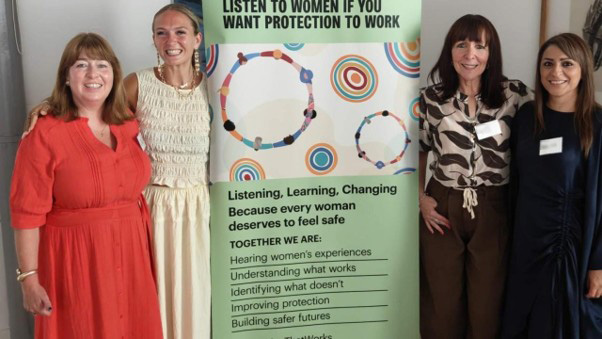
We held a knowledge-sharing and practice exchange event co-designed with the Advisory group and peer researchers. This took place on 16 July 2026, bringing together over 60 people, including stalking survivors, practitioners, and stakeholders from across West Yorkshire. Speakers included women with lived experience of stalking, whose voices, insights, and experiences were at the heart of the event. We were also delighted to be joined by colleagues from a number of police forces across the country, creating valuable opportunities for shared learning and collaboration. The event featured a range of practitioners leading innovative approaches to stalking and victim support, including representatives from Cheshire Police, Greater Manchester Police, Project Shield, the West Yorkshire Stalking Unit, and Safer Steps. Together, speakers and attendees contributed to rich discussions about improving responses to stalking, strengthening support for survivors, and shaping future policy and practice.
View illustrations created at the event by a live scribe on LinkedIn.
On 14 January 2027 we will host an event in central Leeds where we will share findings and work with attendees to plan further actions to protect stalking victims. If you are interested in attending, please contact Daisy Matthews at [email protected].
Driving Change
Our findings will inform:
- Police training and professional development
- Good practice guidance on SPOs and protective orders
- Policy briefings for police, courts, prosecutors, support services, and government
- Regional and national events during Stalking Awareness Week and beyond